


Physics practical exams can be challenging, but with the right approach and preparation, you can excel. Here’s a comprehensive guide to help you navigate your practical exams with confidence:
1. Understanding Key Concepts
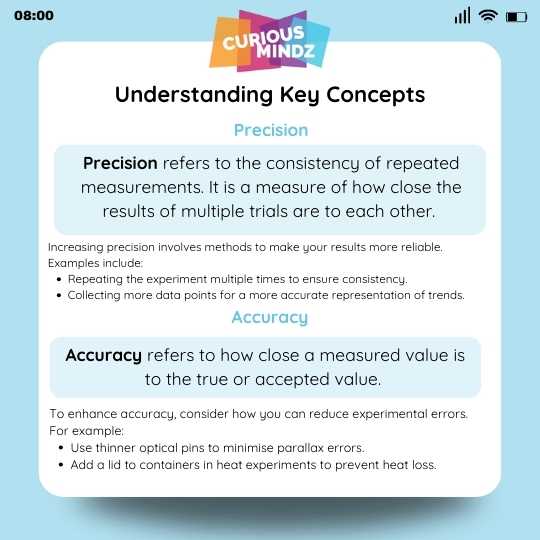
Precision vs. Accuracy
- Precision refers to the consistency of repeated measurements. It is a measure of how close the results of multiple trials are to each other. High precision means that repeated measurements yield very similar results, even if they are not close to the true value.
- Accuracy refers to how close a measured value is to the true or accepted value. High accuracy means that the measurement is very close to the actual value, regardless of the consistency of multiple measurements.
In summary, precision is about consistency, while accuracy is about correctness.
Improvements to Accuracy
To enhance accuracy, consider how you can reduce experimental errors. For example:
- Use thinner optical pins to minimise parallax errors.
- Add a lid to containers in heat experiments to prevent heat loss.
Improvements to Precision
Increasing precision involves methods to make your results more reliable. Examples include:
- Collecting more data points for a more accurate representation of trends.
- Repeating the experiment multiple times to ensure consistency.
2. Data Handling and Calculations
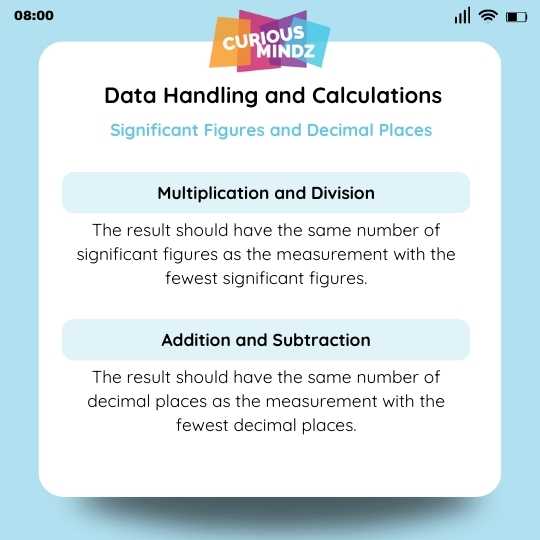
Significant Figures and Decimal Places
- Multiplication and Division: The result should have the same number of significant figures as the measurement with the fewest significant figures.
- Addition and Subtraction: The result should have the same number of decimal places as the measurement with the fewest decimal places.
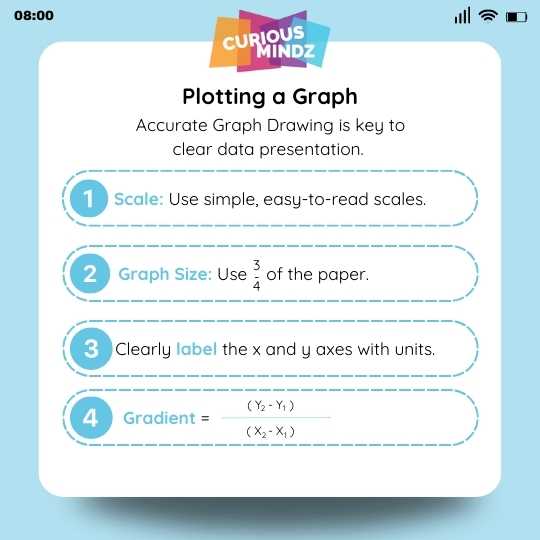
Graphing
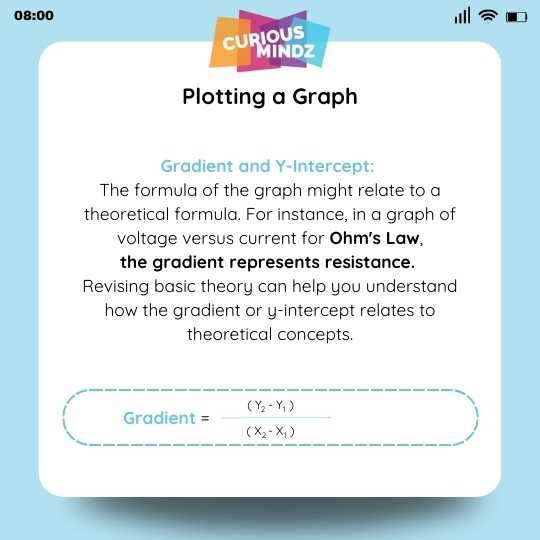
- Gradient and Y-Intercept: The formula of the graph might relate to a theoretical formula. For instance, in a graph of voltage versus current for Ohm’s Law, the gradient represents resistance. Revising basic theory can help you understand how the gradient or y-intercept relates to theoretical concepts.
- Axis and Plotting: Label your axes correctly and include units. Plot data accurately and use a line of best fit if applicable.
3. Measurement and Tabulation
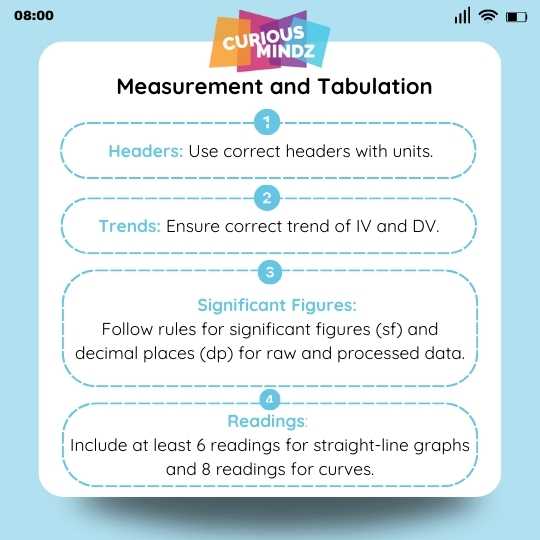
Table Rules
- Readings: Include at least 6 readings for straight-line graphs and 8 readings for curves.
- Headers: Use correct headers with units (e.g., time in seconds (t/s)).
- Trends: Ensure the correct trend of independent variable (IV) and dependent variable (DV) data.
- Range: The range of IV should cover more than half of the maximum possible range.
- Significant Figures: Follow rules for significant figures (sf) and decimal places (dp) for raw and processed data.
Final Encouragement
Whatever is coming out is probably what you have done before! Do not feel nervous and trust the process. Practical exams are about familiarity and practice. Stay focused, manage your time wisely and apply these tips to perform effectively. You’ve got this!
About Curious Mindz
Curious Mindz offers expert-led online tuition programmes in Singapore for Primary and Secondary students, covering English, Math and Science.
Our small-group live classes are designed to help your child build strong academic foundations, develop confidence and achieve success in school and national exams. Whether your child is preparing for PSLE, O-Levels or N-Levels, or simply needs academic support, we’re here to help.
Book your Free Trial Class today and experience the difference with Curious Mindz!